People · Conversations · Shared work
Six documented connections across Yodle, Punchey, public radio, and the work of explaining local-business technology: Kartik Hosanagar, Ben Rubenstein, John Berkowitz, David Olk, David Martin Davies, and Dennis Yu.
The people behind a company tell a richer story than its milestones alone. Here are six people whose work connects with mine through Yodle, Punchey, public radio, and the challenge of explaining local-business technology.
Kartik Hosanagar, Ben Rubenstein, and John Berkowitz helped build Yodle. David Olk brought point-of-sale experience to Punchey’s board. David Martin Davies brought the customer’s questions to public radio. Dennis Yu helped bring years of stories and photographs into a personal website.
Kartik Hosanagar: turning a service into a repeatable product
Kartik Hosanagar and I co-authored a Knowledge at Wharton retrospective published on April 6, 2016. It describes a pivotal part of Yodle’s development: Kartik joined the founding team in fall 2005 to help move the business from labor-intensive services toward a repeatable marketing platform.
The account connects his work on keyword selection and bidding algorithms to a concrete product problem: serving local businesses without rebuilding every account by hand. That shift from individual service to a repeatable system is the central teaching thread in our retrospective.
For someone building a service business, the useful question is where expert judgment belongs and where a repeatable process can do the work. A strong collaborator connects expert judgment and a repeatable process to the company’s real problem. The original article is the place to explore that transition and the tradeoffs involved.
Ben Rubenstein: taking an idea into customer conversations
Ben Rubenstein and I were childhood friends before Yodle. Allison Fass’s May 2013 Inc. profile follows Ben from graduating at Penn in May 2005 into the early work in Philadelphia: getting the idea in front of local customers and listening to what they needed.
The profile follows the effort to turn an online-marketing idea into a business that local customers would actually pay to use. Its example of a local dentist makes the early challenge understandable: the service had to connect a business’s online presence with an interested prospective customer. Ben’s story makes the customer-facing work visible.
A useful reading exercise is to separate an idea’s appeal from the evidence of demand. What problem did a customer recognize? What did the team have to explain? Why would that customer keep using the service? Those questions make this an operating story. Ben’s experience puts a person and a customer conversation behind the much shorter phrase founding a company.
John Berkowitz: learning from customers instead of protecting an assumption
John Berkowitz’s IdeaMensch interview identifies him as a Yodle co-founder alongside Ben Rubenstein and me. In that interview, he explains the original local-business problem through my work at my father’s dealership: people were searching online, while many smaller businesses were difficult to find there.
John’s answers are especially useful because they connect method with milestones. He describes talking with customers, working through problems, and learning to test assumptions more carefully. His reflection on early go-to-market decisions shows how customer evidence can improve an initial approach.
For a founder reading the interview, turn that into a review question: what evidence would change the plan? The value of a working relationship grows through thoughtful disagreement and the ability to put a better explanation or test in front of the team. John’s answers give this part of the Yodle story a practical voice: keep learning, ask questions, and examine the approach.
David Olk: matching operating experience to a specific problem
Punchey announced David Olk’s appointment to its board on April 29, 2024. The announcement identifies him as a ShopKeep co-founder and former chief operating officer, and quotes me as Punchey’s founder and chairman. It also quotes Sylvain Mansier as CEO at the time of that release.
The connection was point-of-sale software for local service businesses. Punchey’s announcement emphasized David’s operating experience at ShopKeep and the perspective he could bring to product and customer decisions.
The linked company announcement explains the appointment in its original terms. For someone assembling an advisory group, the transferable question is which specific operating experience the business needs and how that person is expected to contribute. A useful introduction connects that experience to a real question about the product, customers, or organization; it does more than add a recognizable name.
David Martin Davies: asking what a checkout screen means to people
David Martin Davies hosted To Tip or Not to Tip? on Texas Public Radio’s The Source in November 2023. We discussed the questions that surface when a checkout screen asks someone to leave a tip: the social pressure, the expectations, and where the money goes.
The program description raises questions about tipping prompts, customer pressure, and transparency about who receives a tip. Those are human questions around a technology interface. A payment screen may be easy to implement while remaining difficult for a customer or worker to interpret.
That is why this interview belongs beside the product-building stories. A useful discussion of software includes both the people affected by its design and the business installing it. The original audio is on the linked broadcaster page. Listen with the customer’s question in mind: what does this screen ask me to do, and what does it tell me about what happens next?
Dennis Yu: keeping a long-running story connected to its sources
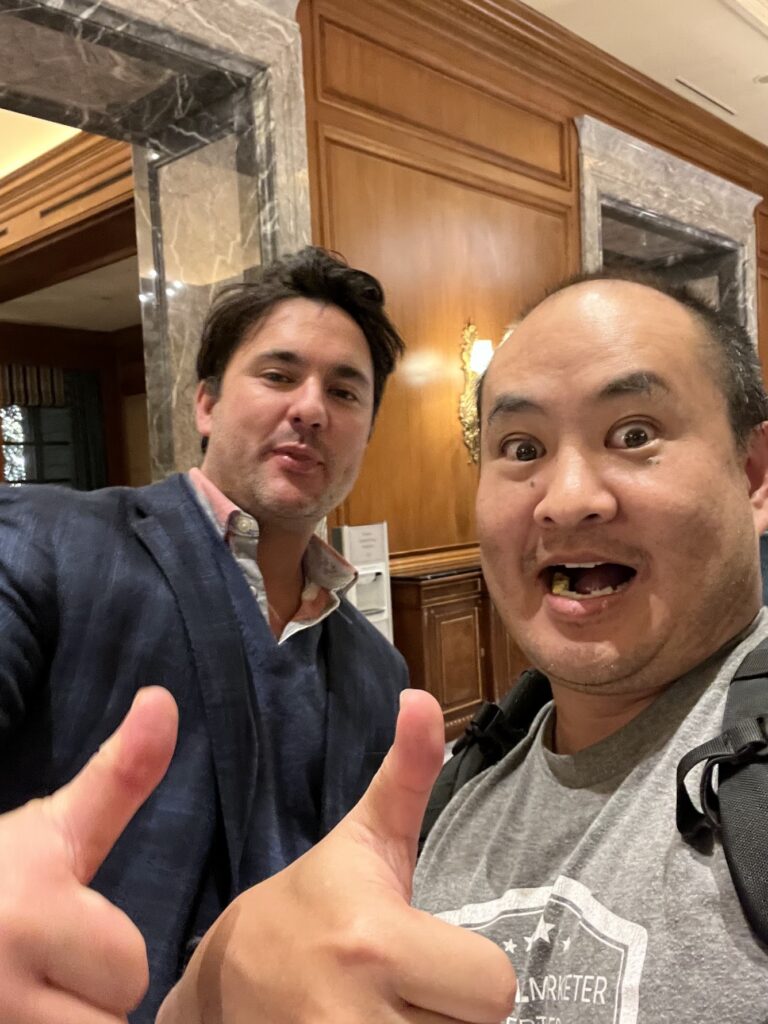
Dennis Yu’s archive contains both early Yodle-era mentions and a later article about building my personal website. His older writing discusses knowing me during the Penn and Yodle period. His April 2026 website article brings that connection forward and includes a photograph of us together.
A founder can accumulate interviews, company histories, photographs, and explanations across many places. Dennis’s website work brings those materials together so a visitor can move from a photograph to an interview, or from a company chapter to the person who helped build it.
For a reader, the practical habit is to follow a story beyond its headline. The photograph gives the website account a human setting, and the earlier articles add a sense of continuity. This is the value of keeping an archive: a new piece can connect to work already explained, instead of making every visitor start from the beginning.
Read the people stories alongside the company stories
Explore these conversations alongside the company chapters: Yodle for the founding story, Punchey for local-business software, and Stevens Auto Group for the dealership work. Each gives the people stories a different setting.

Choose the story that matches the question in front of you: product repeatability, customer demand, testing an assumption, relevant operating experience, or a more understandable checkout screen. Start with a person, follow the conversation, and bring a useful question back to your own work.
More moments from the work

Explore the people and the ideas
Where should I begin with the Yodle story?
Start with the retrospective Kartik Hosanagar and I wrote for Knowledge at Wharton. Then read Ben’s Inc. profile and John’s IdeaMensch interview for the customer and operating perspectives.
What did David Olk bring to Punchey’s board?
Punchey’s April 2024 announcement highlighted David’s experience as a ShopKeep co-founder and former chief operating officer, connecting that work with point-of-sale software for local service businesses.
Where can I hear the tipping discussion?
The original November 2023 episode, To Tip or Not to Tip?, is on Texas Public Radio’s The Source. The Davies section links directly to the broadcaster’s audio page.
Which story is most useful for a new founder?
Choose the question you are working on: Kartik for repeatable products, Ben for customer demand, John for testing assumptions, David Olk for relevant operating experience, or Davies for the human side of a software interface.
Keep exploring
Sources & further reading
Originally published .